




Source: vnexpress.net
AI Will Become a Decision-Making Partner in the Workplace, Says Salesforce Vietnam Country Director
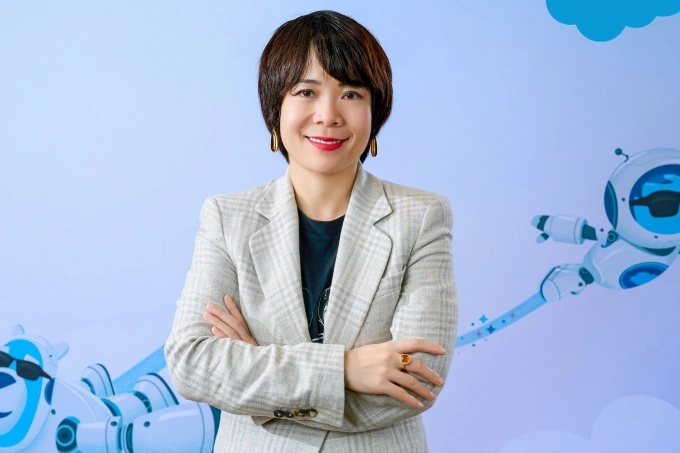
Ms. Quy Nguyen, Country Director of Salesforce Vietnam, believes that in the near future, the workplace will no longer be driven solely by humans — AI will also play a role in decision-making.
Salesforce, a global software corporation founded in 1999 in San Francisco, provides management platforms for millions of businesses worldwide. In late 2025, the company drew attention when it replaced 4,000 customer support staff with AI systems to improve efficiency. As Vietnam’s Artificial Intelligence Law is set to take effect on March 1, Ms. Nguyen shared her perspectives on Vietnam’s rare opportunity with AI, emphasizing that only those willing to adapt will be able to seize it.
AI: A Threat or a Natural Response to New Technology?
When asked whether concerns about “mental atrophy” from over-reliance on AI are alarming warnings or natural reactions to new technology, Ms. Nguyen acknowledged that such concerns are understandable, as with any emerging technology. However, she stressed that society cannot afford to simply “wait and see.”
AI is evolving rapidly and setting new standards for work. Those who stay outside this transformation face greater risks. Instead of fearing consequences, individuals should maintain an open mindset, keep pace with change, and learn how to integrate AI responsibly into their work.
This requires critical thinking and the ability to evaluate AI-generated results. Users must develop the capacity to work alongside AI assistants, ask the right questions, and identify potential biases.
Young professionals, she noted, should cultivate soft skills such as adaptability, accountability, and collaboration — uniquely human qualities that provide a competitive edge in hybrid workplaces combining humans and AI.
“We may well be the last generation working in an environment entirely operated by humans,” she said, predicting that workflows will be redefined as AI assistants increasingly take on shared responsibilities.
Vietnam’s Position in the AI Race
Vietnam is one of Southeast Asia’s fastest-growing digital economies, with a rapidly expanding AI services market. Government support, public–private investments, and ongoing digital transformation across sectors are key drivers.
According to the 2025 World AI Index published by the Worldwide Independent Network of Market Research (WIN), Vietnam ranks among the top 10 countries in AI awareness and readiness. By 2040, AI is expected to contribute USD 130 billion to Vietnam’s GDP — equivalent to 25% of its current economic size.
With a young, tech-savvy workforce and the advantage of not being constrained by outdated infrastructure, Vietnamese enterprises hold significant potential to “leap into the agentic era.” Businesses can accelerate their transition toward AI-agent-enabled models, creating new workforce structures where humans and AI agents collaborate.
By leveraging an unlimited digital workforce of AI agents, Vietnamese companies can unlock unprecedented productivity, enhance customer experiences, and scale operations beyond traditional headcount limitations.
In practice, Vietcombank has already applied AI to build comprehensive customer profiles, while Fulbright University Vietnam uses AI agents as assistants capable of answering students’ inquiries.
Challenges in AI Implementation
Despite these opportunities, many businesses still struggle with AI adoption. The primary barrier, according to Ms. Nguyen, is data readiness. Fragmented systems and decentralized data prevent AI from realizing its full potential.
To succeed, companies must develop a clear data strategy from the outset, beginning with a unified, reliable data platform capable of real-time activation. High-quality data is essential for generating accurate AI outputs.
Another obstacle is the skills gap. The World Economic Forum’s Future of Jobs Report indicates that 62% of Vietnamese businesses identify skills shortages as their biggest transformation challenge. Meanwhile, 59% of Vietnamese workers will require reskilling or upskilling by 2030. This underscores the importance of investing in human capital.
Some argue that AI is being “overhyped,” potentially leading to overinvestment and inefficiency. Ms. Nguyen believes that if businesses invest in AI based on practical needs aligned with strategic objectives, the risk of redundancy remains relatively low.
She advises companies to begin with investments that generate clear value before scaling. Importantly, businesses should collaborate with technology partners rather than attempting to build AI solutions independently.
Developing AI in-house often leads to difficulties in real-world deployment, even after significant infrastructure investment, as AI systems are frequently added onto existing processes rather than designed for seamless integration.
Vietnam’s Artificial Intelligence Law
Regarding Vietnam’s Artificial Intelligence Law, effective March 1, Ms. Nguyen views it as a balanced framework that manages risks while encouraging innovation, aligned with international best practices.
Risk-based and practical regulatory frameworks with high compatibility can positively impact AI development and adoption. For businesses, this presents an opportunity to develop products within established ethical standards and prioritize responsible technology development.
Early regulation provides clearer direction for safe and ethical AI implementation, accelerating deployment nationwide. However, she emphasized that AI governance frameworks should be built on collaboration among government, businesses, and social organizations.
“Innovation and trust are not opposites,” she noted. Governance and safety mechanisms are not barriers but catalysts for AI advancement.
AI’s Impact on Vietnam in 2026
AI is evolving from predictive chatbots toward agents capable of delivering stable, reliable, and secure outcomes.
Over time, businesses will recognize that large language model intelligence alone is insufficient. To transform intelligence into predictable and trustworthy results, AI must connect with accurate data, business logic, and governance mechanisms.
For Vietnam, AI presents a transformative opportunity, particularly for micro, small, and medium-sized enterprises (MSMEs), which account for 98% of all businesses. AI agents can address resource constraints and enable small firms to scale operations, compete with larger enterprises, and enhance service capabilities.
AI agents also stimulate innovation, allowing entrepreneurs to pursue ideas and launch scalable business models with minimal initial investment. AI could drive a bottom-up economic transformation as more SMEs adopt AI solutions. The emergence of localized AI applications will further address domestic challenges effectively.
In this context, AI is not merely a technology — it is a test of adaptability for Vietnamese businesses and workers alike.



.jpeg)
.jpeg)