




Source: vnexpress.net
In addition to Turtle Lake and Ben Thanh Market, many historic buildings, old apartment blocks, and public facilities in central Ho Chi Minh City have recently undergone renovation, presenting a noticeably refreshed appearance.
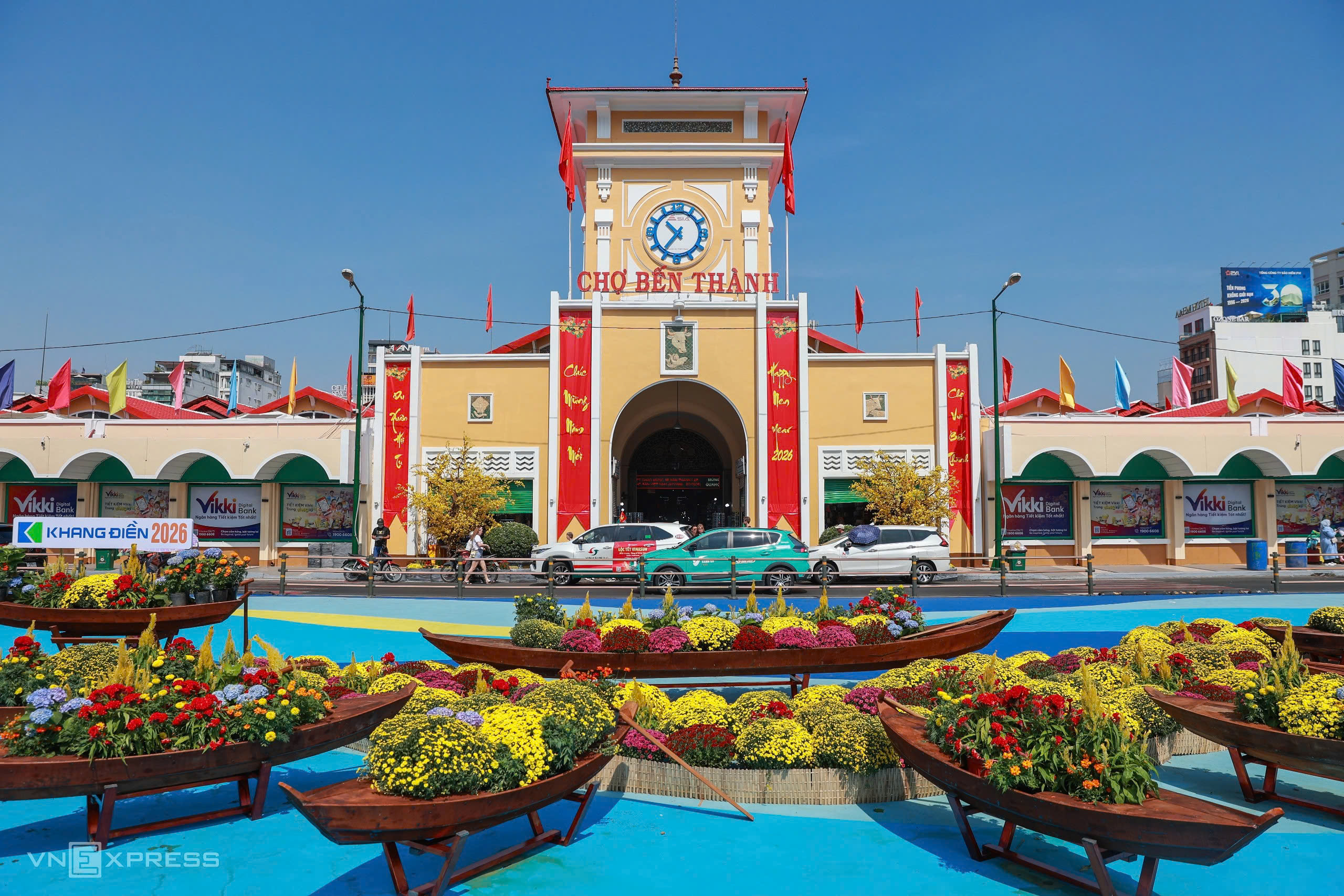
On February 4, barricades surrounding the traffic islands in front of Ben Thanh Market were removed, allowing the public to access the area. The building’s walls and roof were repainted while preserving its original architectural details and decorative motifs.
The square in front of the market, however, was redesigned with large wave-inspired patterns in multiple colors, drawing public attention and sparking debate.
The market’s tiled roof has been repainted in deep red, while the surrounding traffic islands feature blue wave-shaped designs.
According to representatives of the sponsoring unit, the wave motif was selected based on the cultural and historical characteristics of southern Vietnam, closely associated with its extensive canal network. The Ben Thanh area was once located along the Ben Nghe River; although the market was later relocated to its current site, it retained its historic name.
Interwoven among the wave patterns are images of boats docking and spring floral arrangements. The incorporation of water-themed elements aims to create a landscape highlight while linking the area’s historical identity with the modern urban setting.
Turtle Lake Refreshed
Approximately 1.5 kilometers away, renovation work at Turtle Lake has also been completed, with scaffolding removed. The central tower has been repainted in a brighter tone, sidewalks have been cleaned, and additional greenery has been added. The staircase, originally painted blue, has been changed to a white-gray palette.
The surrounding park area has been landscaped with flowers and decorative features to create a more harmonious overall appearance.
Although renovation at Turtle Lake and Ben Thanh Market has largely been completed, the choice of colors in certain areas has generated mixed opinions. Recently, the Department of Planning and Architecture proposed suspending further renovation work in the two square areas due to color schemes differing from the originally approved design.
Historic Railway Building and Nearby Structures
Near Ben Thanh Market, the headquarters of Saigon Railway Transport Joint Stock Company (136 Ham Nghi Street) has completed renovation. The walls have been repainted in a deeper yellow tone.
Constructed in 1914, the building originally bore the name Bureau du Chemin de fer of the Indochina Railway Company, commonly known as the “Railway Building.” Before 1975, it served as the headquarters of the Ministry of Transport and Post under the former Saigon government. The area once functioned as the Saigon Railway Station, where lines extended to Hanoi, Loc Ninh, and My Tho.
The roof tiles have been repainted in dark red, harmonizing with the roof of Ben Thanh Market and nearby historic buildings along Le Loi Street. The paint color was reportedly inspired by the Ho Chi Minh City Central Post Office.
Adjacent historic houses along Le Loi Street, as well as buildings along the route, have also been refurbished over the past month, creating a cleaner and more polished urban façade.
Wider Urban Improvements
Beyond historical structures and apartment buildings, Ho Chi Minh City has also upgraded traffic intersections and public works throughout the city. These projects are scheduled for completion before February 10 (23rd day of the lunar December).
Opposite Ben Thanh Market, the corner building at Ham Nghi – Pho Duc Chinh streets has been renovated with dominant yellow and sky-blue tones across its floors and corridors.
About 300 meters away, the building row at the corner of Ham Nghi – Pasteur streets completed renovation roughly 10 days earlier, highlighted by a newly painted red roof replacing the previously rusted surface.
The well-known apartment building at 42 Nguyen Hue Street shows minimal changes. Built in the 1960s and approximately nine stories high, it remains a popular destination for young people and tourists. Many units have been converted into cafés and shops, contributing to the unique character of the city center.
Meanwhile, the apartment block at the Nguyen Hue – Ton Duc Thang intersection has undergone more noticeable changes, with a dominant yellow-and-blue color scheme.
The three-story building at the corner of Dong Khoi – Ngo Duc Ke streets has been repainted in brighter tones, while its signage, balconies, and surrounding greenery have also been improved.




.jpeg)
.jpeg)